
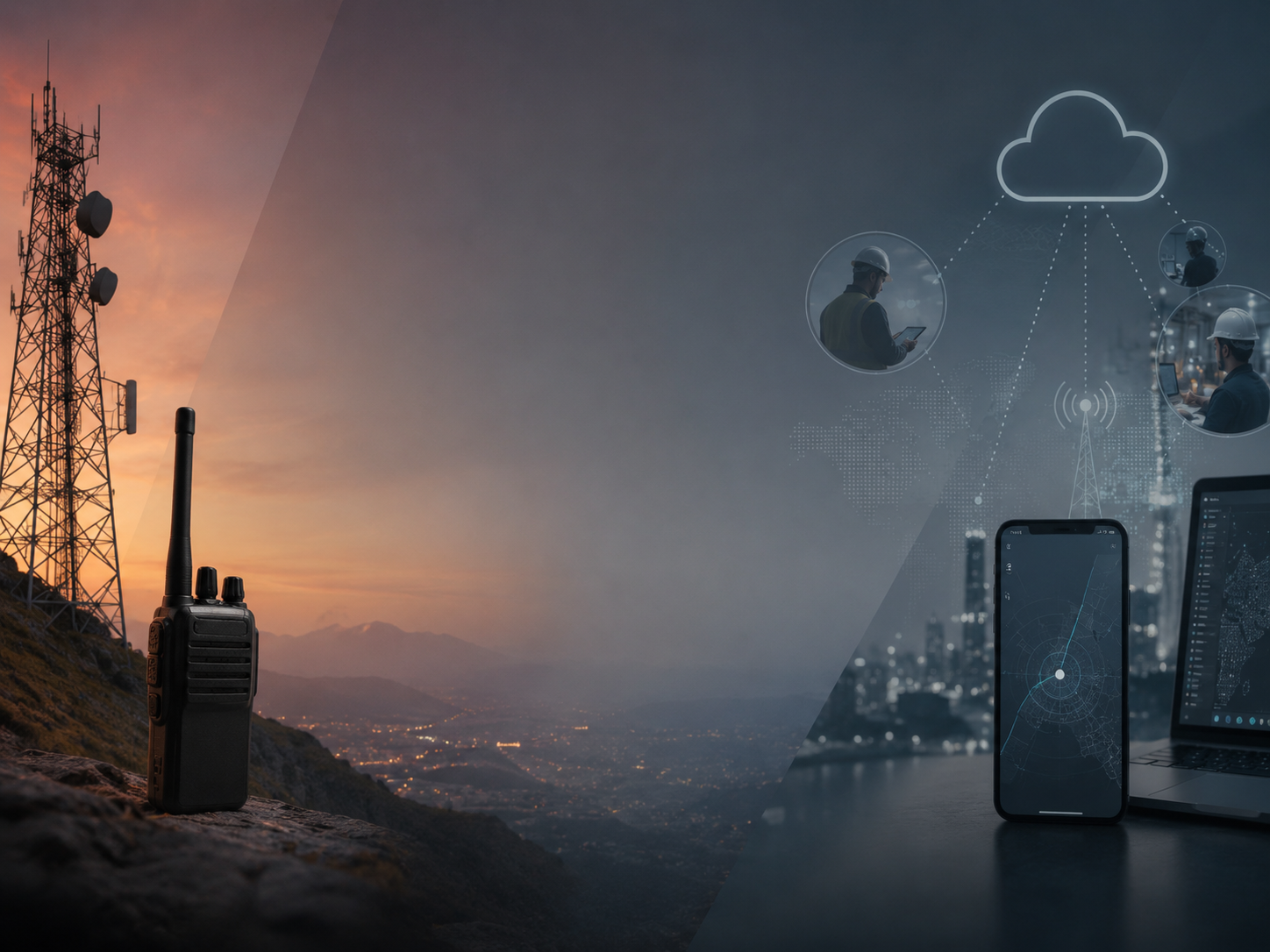
Poor two-way radio audio doesn’t just frustrate staff, it slows operations, causes mistakes, and can become a genuine safety issue. Addressing two-way radio audio quality is a major area to get better comms.
In industries like construction, warehousing, transport, security, and events, clear communication matters. If your team is constantly saying “repeat that” or missing critical messages, there’s usually an underlying cause that can be fixed.
Here are the biggest reasons business radios have poor sound quality and what you can do about them.
1. Choose the right radio technology
Not all radio systems perform the same. Older analogue radios are particularly vulnerable to:
- Static
- Interference
- Signal degradation
- Background noise
Modern digital systems such as DMR and Push-to-Talk over Cellular (PoC) provide significantly clearer audio.
DMR (Digital Mobile Radio): DMR improves voice clarity and reduces background hiss compared to analogue systems.
Push-to-Talk over Cellular (PoC): PoC often delivers the best overall audio quality because it uses digital cellular networks instead of traditional radio transmission. Leading PoC solutions also have optionality in the form of digital transmission, making optimisation for different clients and purposes possible. Kirisun PoC can be set up using any of the below
Speex 8 kbps → A low-bitrate open-source VoIP codec (compressed, lower quality but efficient)
AMR-NB 12.20 kbps → Adaptive Multi-Rate Narrowband (standard cellular voice codec, ~telephone quality)
AMR-WB 23.85 kbps → Adaptive Multi-Rate Wideband (HD voice, much clearer audio)
OPUS 32 kbps → Modern, high-quality low-latency codec (used in apps like Discord, WhatsApp, etc.)
This means:
- Clearer voice reproduction
- More consistent audio
- Better performance over distance
If audio quality is a major issue, upgrading technology is a fundamental start point.
2. Improve coverage
One of the biggest causes of poor audio is weak signal strength. When radios operate at the edge of coverage, audio becomes:
- Broken
- Delayed
- Robotic
- Difficult to understand
This is especially common:
- Inside warehouses
- Around concrete or steel structures
- In hilly terrain
- Across large sites
Solutions:
- Add a repeater (for UHF/VHF systems)
- Improve antenna placement and/or radiation pattern
- Use higher-gain antennas
- Move to a PoC system with wider coverage
In many cases, what sounds like an “audio issue” is actually a coverage issue.
3. Use quality speaker microphones & earpieces
Cheap accessories ruin good radios.
Low-quality speaker mics often:
- Distort audio
- Pick up excessive background noise
- Fail in noisy environments
Investing in commercial-grade accessories can dramatically improve clarity.
For noisy environments consider:
- Noise-cancelling speaker microphones
- Acoustic tube earpieces
- Heavy-duty industrial headsets
These are particularly valuable in:
- Warehouses
- Manufacturing
- Civil construction
- Transport yards
4. Train staff on proper radio technique
Even excellent radio systems sound bad when used incorrectly.
The most common mistakes:
- Talking too close to the microphone, and not across it
- Holding the radio too far away
- Speaking before pressing PTT fully
- Talking too fast
- Covering the microphone with gloves or clothing
Best practice:
- Hold microphone 5–10cm from mouth
- Hold microphone at an angle and talk across it
- Pause briefly after pressing transmit
- Speak clearly and steadily
- Keep messages short
Simple training can noticeably improve communication quality across an entire team.
5. Reduce background noise
Industrial environments are loud. Forklifts, engines, machinery, wind, and crowds all impact intelligibility.
Modern digital radios now include:
- AI noise reduction
- Digital noise suppression
- Wind noise filtering
But accessory choice and microphone positioning still matter enormously.
In very noisy environments, a headset is often the single biggest improvement you can make.
6. Check your radio programming
Poorly programmed radios can create unnecessary audio problems.
Issues can include:
- Incorrect squelch settings
- Poor gain configuration
- Wrong bandwidth settings
- Incorrect digital parameters
This is especially common when:
- Radios were sourced cheaply online
- Multiple brands are mixed together
- Systems have evolved over time
A professional system audit can often uncover hidden issues affecting performance.
7. Maintain batteries & hardware
Weak batteries affect transmission quality more than many people realise.
As batteries age:
- Transmit power can drop
- Audio performance becomes inconsistent
- Radios may behave unpredictably
Also check for:
- Damaged antennas
- Dirty microphone ports
- Water ingress
- Loose accessory connections
Regular maintenance prevents many “mystery” audio issues.
8. Match the solution to the environment
The best communication system depends on how and where your team operates.
DMR works well when:
- Teams operate within a fixed area
- Cellular coverage is limited
- Independent infrastructure is required
PoC works well when:
- Teams operate across multiple sites
- Coverage consistency matters
- Staff travel between regions
- Clear digital audio is a priority
There’s no one-size-fits-all answer, but there is usually a best-fit solution.
Summary
Most radio audio issues are fixable.
Better sound quality usually comes down to:
- Better coverage
- Better equipment
- Better accessories
- Better system design
The difference between a frustrating radio system and a high-performing one is often much smaller than businesses think.
Want to improve your team’s radio performance?
At Signals, we help businesses:
- Service a wide selection of brands, with parts for key brands available
- Diagnose coverage and audio issues
- Optimise existing radio systems
- Compare DMR vs PoC solutions
- Trial equipment in real environments
Let our team know if we can help with any of these. See our radio service and radio repairs pages, or call 0800 454 756.
Related guides: DMR vs push-to-talk over cellular · When to install a repeater at your site