
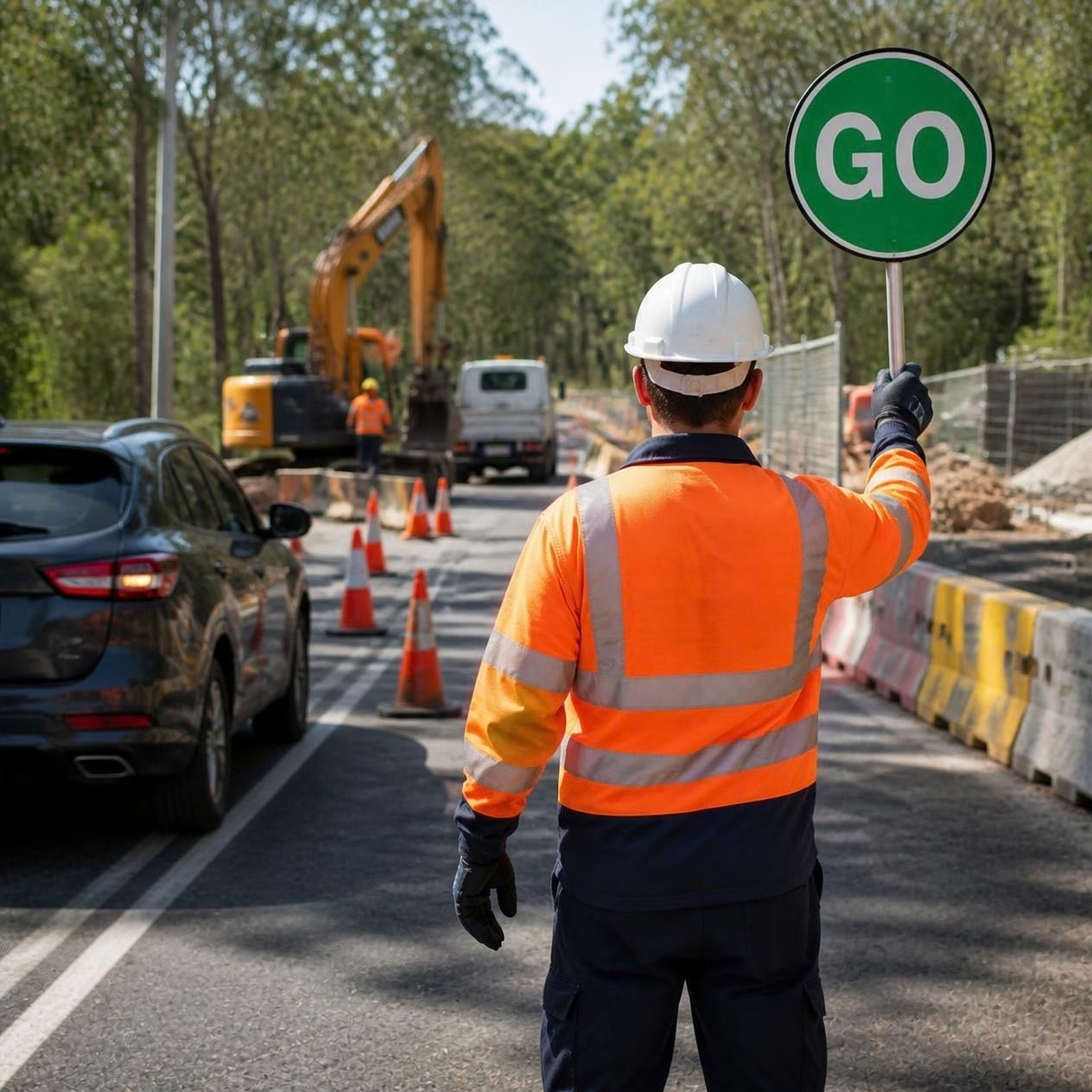
Traffic management crews do some of the most exposed work in New Zealand. They stand beside live traffic, often at night, often alone at one end of a site, relying on drivers they can’t control to slow down and stop. When something goes wrong — a driver ignores the paddle, a vehicle breaches the coned area, a worker is threatened — the crew’s ability to warn each other in seconds is what stands between a near miss and a serious injury.
For years that job has fallen to UHF handheld radios and mobile phones. Both still have their place, but push-to-talk over cellular (PoC) radio now gives traffic management companies something neither can on its own: instant, one-button group talk that works anywhere there’s mobile coverage, with GPS, SOS and a dispatcher console built in. Here are seven ways it improves both safety and day-to-day operations.
The risks traffic management crews face
A survey of nearly 700 New Zealand road workers, released in October 2025 by the Temporary Traffic Management Industry Steering Group (TTM-ISG) and the Traffic Management Association of Australia, paints a stark picture:
| Figure | What road workers reported |
|---|---|
| 65% | Drivers refusing to stop at least once a week |
| 60%+ | Verbal abuse every week |
| 50% | Near misses involving distracted or speeding drivers |
| 20% | Physical assault on the job |
| 4% | Struck by a vehicle in the past 12 months |
The same release noted 356 people killed or seriously injured at road worksites between 2019 and 2023, including 42 deaths. And in January 2026, a council contractor working on foot on the Taihape–Napier Road in Hawke’s Bay died after being struck by a vehicle; WorkSafe and police opened a joint investigation.
At the same time, the industry has moved from CoPTTM to the risk-based New Zealand Guide to Temporary Traffic Management (NZGTTM), with road controlling authorities requiring NZGTTM-format traffic management plans from 1 July 2026. A risk-based approach puts more weight on how well a PCBU actually understands and controls the risks on each job, and communication between workers is a control that touches almost every one of them.
1. Talk across the whole site, whatever its length or shape
Stop/go operators at each end of a long site, a bend, a hill or a bridge often can’t see each other and traditional radios can struggle with the same terrain. Because PoC radio runs over the mobile network, range isn’t limited by line of sight or radio power. The operator at one end can talk to the operator at the other end of a 2 km shuttle as clearly as to the person next to them.
That means fewer “is it clear?” delays, fewer vehicles released into each other in a single-lane section, and less reliance on guesswork or hand signals at a distance. For crews on short, compact sites in areas with poor mobile coverage, licensed simplex radio still has a role, and the two can be used side by side.
2. Warn the whole crew in one press
When a driver ignores the paddle or a vehicle speeds through the taper, the people downstream have seconds to react. With PoC, one press of the button reaches every worker in the talk group at once — “silver ute through the stop, coming your way” — so the crew can step clear, rather than a single phone call reaching one person while everyone else is unaware.
With 65% of road workers reporting drivers refusing to stop at least weekly, a fast, crew-wide warning is one of the simplest and most effective controls available.
3. Raise an alarm when a worker can’t
Traffic controllers are frequently alone at one end of a site, at night or in remote locations, and one in five road workers in the survey reported being physically assaulted. Rugged PoC handsets such as the Kirisun T60 and T65 include a dedicated SOS button that sends an emergency alert, with the worker’s location, to the supervisor, the rest of the crew and the dispatcher. Where man-down features are enabled, an alarm can also be triggered automatically if a worker falls or stops moving.
That turns “we didn’t know until we went looking” into an immediate, located alert — which matters for workers in danger and for a PCBU’s duty to manage the risks of working alone.
4. See every crew on a live map
PoC radios report their GPS position to a web-based dispatcher console. Operations managers can see where every crew and vehicle is, in real time, without a single phone call. That makes it much easier to:
- Send the nearest crew to an urgent call-out or incident response job.
- Confirm a crew has arrived on site and the set-up has started.
- Find a worker quickly when an SOS alarm comes in.
- Plan resources across multiple sites on the same day.
5. Run multiple sites and crews from one console
Traffic management companies rarely run one job at a time. With PoC, each site, crew or contract can have its own talk group, so crews only hear the traffic that matters to them. Supervisors and the dispatcher can monitor several groups at once, talk to one crew or broadcast to all of them — for example, to pass on a weather warning, a road closure or a change of plan.
Because it all runs through a browser-based dispatcher console, the office can manage crews spread across a region without installing repeaters or building a radio network.
6. Build a better record of what happened
NZGTTM’s risk-based approach expects PCBUs to understand and evidence how they’re managing risk on each job. PoC location history from the dispatcher console helps show where crews were and when, which is useful for checking set-up and pack-down times, answering client queries and supporting incident investigations. Talk to your provider about which records are kept, and for how long, so they line up with your safety management system.
7. Simplify fleets and cut communication costs
A PoC radio does the job that often took two devices: a two-way radio for the crew and a phone for the office. There’s no repeater infrastructure to build or maintain, no need to move base stations when work moves, and no frequency licence to manage for each region. New crews can be added to the right talk group in minutes from the console.
In-vehicle PoC mobiles let truck-mounted attenuator (TMA) and shadow vehicle drivers stay on the same talk group as the crew on foot, and the same handsets work whether the crew is in Invercargill or Auckland.
PoC radio vs UHF radio vs mobile phones
| PoC radio | UHF simplex radio | Mobile phone | |
|---|---|---|---|
| Range | Anywhere with mobile coverage | Limited by terrain and power | Anywhere with mobile coverage |
| One-to-many instant talk | Yes | Yes | No |
| Works without mobile coverage | No | Yes | No |
| GPS location to office | Yes | No | App-dependent |
| SOS alarm | Yes | No, or limited | App-dependent |
| Dispatcher console | Yes, web-based | No | No |
| Rugged, glove-friendly PTT | Yes | Yes | No |
| Radio licence needed | No | Yes | No |
For most traffic management operations, PoC gives the best mix of reach, safety features and operational visibility. Where crews regularly work in areas with no mobile coverage, a mix of PoC and simplex radios gives the best of both.
Why traffic management companies choose Signals
- New Zealand’s PoC pioneer. Signals built New Zealand’s first push-to-talk over cellular network in 2018 and has run it continuously since.
- The largest PoC fleet in the country. Around 3,500 Signals PoC devices are in the field across transport, waste, security, traffic management and more.
- Exclusive New Zealand distributor for Kirisun, including the T60 and T65 PoC handsets and Kirisun’s web dispatcher console.
- PoC and traditional radio under one roof, so you can mix PoC with licensed simplex radio where coverage demands it.
- Our own technicians in Christchurch and Auckland, working nationwide, with in-house repairs.
Scope your free trial. We’ll work through how your crews operate, set up talk groups and the dispatcher to suit, and put demo radios in your team’s hands on a real job. Call 0800 454 756 or email sales@signals.co.nz.
Related: Radio for traffic management · Lone worker safety in New Zealand · How to choose a PoC radio
Common questions
What is PoC radio?
Push-to-talk over cellular (PoC) radio works like a two-way radio — press the button and talk to your group — but sends voice over the 4G mobile network instead of radio frequencies. That gives it nationwide range, GPS and data features that traditional radios don’t have.
Does PoC radio work in areas with no mobile coverage?
No. PoC relies on mobile coverage. For crews who regularly work in coverage black spots, licensed simplex radios can be used alongside PoC so the crew can still talk directly on site.
Do I need a radio licence for PoC?
No. PoC uses the mobile network, so there’s no frequency licence to apply for or renew.
Can PoC radios help meet NZGTTM requirements?
NZGTTM is risk-based, so it doesn’t mandate a specific type of radio. But reliable communication between workers, fast emergency alerts and location records all support how a PCBU identifies and controls risk on a site.
Can PoC radios be fitted in vehicles?
Yes. In-vehicle PoC mobiles let TMA, shadow and support vehicle drivers stay on the same talk group as the crew on foot.
This article is general information and isn’t legal advice. Responsibility for health and safety and traffic management compliance rests with each PCBU and the requirements of the relevant road controlling authority.
Sources
- TTM-ISG — Road worker survey report media release (October 2025): ttm-isg.org
- 1News — ‘A tragedy’: Road worker dies after being hit by vehicle (14 January 2026): 1news.co.nz
- NZ Transport Agency Waka Kotahi — New Zealand guide to temporary traffic management (NZGTTM): nzta.govt.nz
- Matamata-Piako District Council — NZGTTM transition (1 July 2026 date): mpdc.govt.nz