
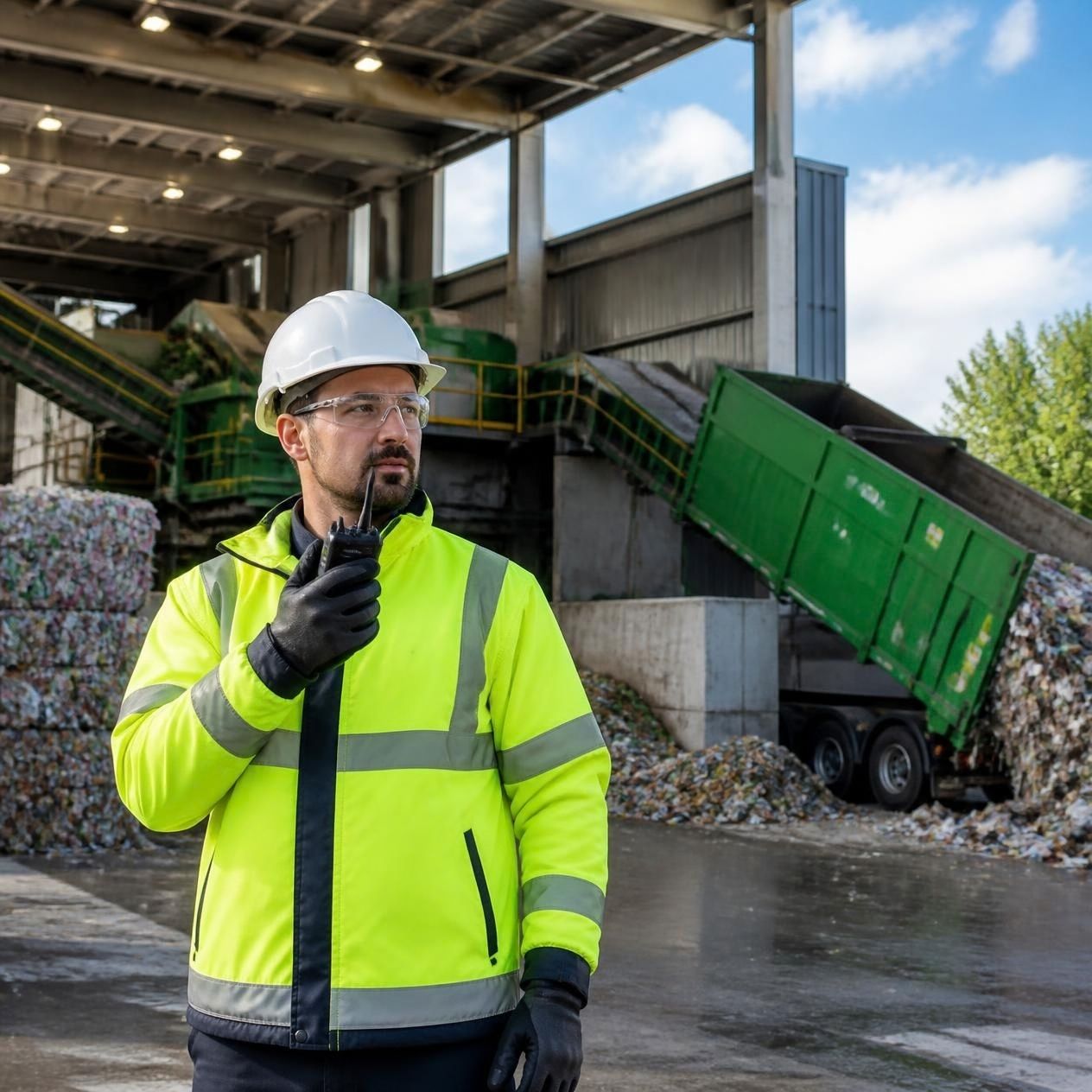
On a busy Saturday morning, a New Zealand transfer station can look more like a small port than a rubbish tip. Trailers and utes queue at the weighbridge. A loader works the pit floor. A truck is reversing to the tipping face. Members of the public, some who have never been on site before, are unloading green waste a few metres from moving plant, while staff direct traffic, sort reusables and keep an eye on the hazardous waste drop-off.
Every one of those activities depends on people knowing what everyone else is doing, right now. When that breaks down, the consequences can be serious. This article looks at what’s happening on New Zealand sites, what the law expects, and why a properly designed two-way radio system is one of the simplest and most effective ways to improve safety for transfer station and recycling centre staff.
Why transfer stations are hard places to keep people safe
Few workplaces combine as many high-consequence hazards in one place as a transfer station or resource recovery centre:
- Heavy plant and the public, side by side. Loaders, excavators, forklifts and trucks share space with untrained members of the public driving cars and towing trailers.
- Tipping and reversing. WorkSafe lists transfer stations as sites where tipping hazards occur, with the main risks being people run over, crushed, or falling from height.
- Fire. Lithium-ion batteries hidden in household waste and recycling can ignite when crushed by compactors and loaders.
- Noise, dust and distance. Plant noise, PPE and the size of the site make shouting or waving an unreliable way to get someone’s attention.
- Staff working alone. Weighbridge operators, gate staff, reuse shop workers and early-opening or closing staff often work out of sight of colleagues.
- Unpredictable loads. Hazardous substances, gas bottles, asbestos and sharps can arrive without warning.
What’s happening on New Zealand sites
A fatality at a Southland transfer station
On 2 May 2025, a WasteCo employee died at the Te Anau transfer station, which WasteCo operated under contract to Southland District Council. In May 2026 WorkSafe charged WasteCo under the Health and Safety at Work Act 2015, with a maximum penalty of $1.5 million. WorkSafe area manager Gary Lowther said: “Businesses and organisations must manage their risks, and when they do not we will hold them to account.”
The case is before the courts and no findings have been made. But it’s a sobering reminder that transfer station work carries the risk of serious harm, even at smaller regional sites.
Battery fires are rising fast
Fires caused by small batteries — especially lithium-ion batteries in vapes, toys, tools and laptops — are now one of the sector’s most visible risks:
- Waste Management NZ recorded 75 battery-related fires across its vehicles and facilities over 12 months (NZ Herald, March 2026).
- Christchurch City Council recorded 40 battery-related fires in 12 months, and Auckland Council 35 since the start of 2025 (NZ Herald, March 2026).
- A WasteMINZ-commissioned Environmental Scan by Eunomia (April 2026) reported “a sharp increase in fires linked to small batteries, particularly lithium-ion batteries, occurring in rubbish trucks, recycling facilities, transfer stations and scrapyards.”
- In February 2026, firefighters from multiple stations attended a fire at the Tirohia landfill near Paeroa, suspected to have started when a compactor drove over an item that ignited. No one was injured.
A battery fire on a tipping floor can go from a wisp of smoke to a fire that endangers staff and the public within minutes. How quickly the alarm is raised, and how quickly everyone on site hears it has a direct effect on the outcome.
Customers among vehicles: a lesson from another industry
Transfer stations aren’t the only sites where the public mix with moving vehicles. In a WorkSafe prosecution of Vehicle Inspection New Zealand (VINZ), a customer was struck by a vehicle driven by an employee at a Hamilton testing site in 2019 and later died. The company was fined $225,000 and ordered to pay reparations. WorkSafe’s comment applies directly to transfer stations: “This was a site where there were a large number of vehicles passing through each day, alongside customers. The risks were well known and there were policies in place, however there was a failure, at least on this occasion, to adhere to them.”
What the law expects of site operators
Under the Health and Safety at Work Act 2015 (HSWA), the business running a transfer station or recycling centre is a PCBU. It must ensure, so far as is reasonably practicable, the health and safety of its workers and it must also make sure that other people, including members of the public using the site, aren’t put at risk by the work.
WorkSafe’s guidance on tipping and site traffic sets out the controls it expects to see, including:
- Keeping people away from trucks during tipping, using exclusion zones, signage and barriers.
- Trained spotters who can “immediately signal the driver to stop if any person or object enters the vehicle movement area.”
- Drivers and site coordinators sharing information about loads and site conditions.
- Where reversing can’t be eliminated, “using radios and other communication systems” — and for larger vehicles, radio contact with the spotter standing in a safe location away from the vehicle.
Communication isn’t a substitute for good site design — separating people from plant comes first. But almost every control on that list depends on people being able to talk to each other instantly.
Where communication breaks down on site
Ask any transfer station supervisor and they’ll recognise these moments:
- A loader operator can’t see a member of the public who has wandered behind them, and the staff member who can see it has no way to tell them.
- Smoke appears in a bunker. Someone has to run to the office to raise the alarm, while the public keep unloading.
- The weighbridge lets through a load with suspected asbestos or gas bottles, but the pit team doesn’t find out until it’s on the floor.
- A staff member working alone at the reuse shop or green waste area is confronted by an aggressive customer, or falls, and nobody knows.
- An incoming collection truck arrives at the tipping face just as a site closure or evacuation is called.
Mobile phones don’t solve these problems. Calls are one-to-one, need dialling, are hard to use with gloves on, and are easy to miss in a noisy pit. On a site where seconds matter, you need one press of a button to reach everyone who needs to know.
How two-way radio improves transfer station safety
- Instant stop-work calls. Any staff member can call “all stop” to every loader, truck and spotter at once. The person who sees the hazard can stop the plant, not just the person in the cab.
- Spotter-to-driver contact. Spotters stay in a safe position away from the vehicle and talk the driver in, as WorkSafe recommends, rather than relying on hand signals through dust and glare.
- Weighbridge-to-pit warnings. Gate and weighbridge staff warn the floor team about hazardous loads, large loads or inexperienced customers before they reach the tipping area.
- Faster fire response. A battery fire can be reported to the whole site immediately, plant can be moved and the public cleared while the emergency call is made.
- Site-wide evacuation. An all-call reaches every handheld and vehicle. Radios linked to an outdoor loudspeaker can also broadcast instructions to customers in public areas.
- Lone worker protection. Radios with emergency (SOS) buttons, and models with man-down or no-movement alarms, alert colleagues if a staff member working alone is hurt or threatened.
- Visiting drivers on the same page. Loan handhelds at the gate let contractors and external truck drivers hear site instructions while they are on site.
Choosing the right radio system for your site
The right system depends on the size and layout of your site, the noise environment, and whether you also need to talk to trucks on the road.
| Site or need | Recommended system | Why |
|---|---|---|
| Small to medium transfer station or recycling centre | UHF simplex (radio-to-radio) handhelds and vehicle radios | Simple, low running cost, no reliance on the cellular network; national simplex licences are available immediately |
| Large or complex site, multiple buildings, steel structures, dips and stockpiles | UHF repeater system with an engineered, licensed channel | Extends coverage across the whole site and into buildings; licensing typically takes one to four weeks |
| Collection fleet travelling between sites | Push-to-talk over cellular (PoC) mobiles with a dispatcher console | Nationwide reach, GPS location, SOS alerts, and talk groups for each run or depot |
| Site team and fleet need to talk | PoC gateway linking the site radio channel to the PoC fleet | Drivers can hear the tipping-face team before they arrive, and dispatch can talk to both |
| Noisy pit and plant operators | Rugged, IP-rated radios with headsets or speaker microphones | Clear audio over plant noise, and built to handle dust, water and drops |
Making radio part of your safety system, not just a gadget
Radios improve safety when they’re built into how the site runs. A few practical steps make a big difference:
- Write a channel plan. For example, separate talk groups for the weighbridge, pit and floor, recycling and reuse, and management, plus an emergency channel everyone monitors.
- Agree a stop-work call. A short, standard phrase that anyone can use and everyone must obey immediately.
- Use call signs, not names. “Loader 1”, “Weighbridge”, “Spotter 2” — so instructions are never ambiguous.
- Include radio in your traffic management plan and emergency procedures, and make sure fire and evacuation calls are tested in drills.
- Test the emergency functions regularly. Check that SOS and man-down alarms reach the right people.
- Manage batteries. A charging routine and spare batteries mean nobody starts a shift with a flat radio.
- Train everyone, including relief and weekend staff, and give visiting drivers a short radio briefing at the gate.
In practice: radio across New Zealand’s waste and recycling sector
A national metal recycling network. One of New Zealand’s larger metal recyclers, with five sites nationwide, uses Signals radio on site, simplex or repeater depending on the yard, with PoC gateways and Kirisun M50 PoC mobiles in vehicles at several sites. Handhelds are issued at the gate to external drivers, and a loudspeaker linked to the radio channel carries instructions across the yard.
How Signals can help
Signals NZ has more than 20 years in the two-way radio industry and designs, licenses, installs and supports radio systems for New Zealand businesses. For transfer stations, resource recovery centres and recycling sites, we offer:
- Site coverage design — we start with how your site works, survey the site, model coverage where a repeater is needed, and test on site after installation.
- Radio licensing handled for you — we apply for, coordinate, hold and renew RSM licences.
- Rugged, value-for-money radios — Signals is the exclusive New Zealand distributor for Kirisun, and an authorised Icom dealer.
- Fleet connectivity — New Zealand’s first push-to-talk over cellular network, built by Signals in 2018, now supporting around 3,500 devices in the field.
- Our own technicians in Christchurch and Auckland, working on site nationwide, with in-house repairs and quick turnarounds.
Talk to us about a radio system for your site. Call 0800 454 756 or email sales@signals.co.nz. We can scope a free trial with demo radios so your team can test them on a real working day.
Related: Lone worker safety in New Zealand · How to choose a PoC radio · Radio for waste and recycling
Common questions
Do transfer stations need two-way radios by law?
No law names two-way radios specifically. But HSWA requires site operators to manage the risks to workers and the public so far as is reasonably practicable, and WorkSafe’s site traffic guidance recommends radios and other communication systems where reversing and spotting can’t be eliminated.
Are mobile phones good enough for site communication?
Phones are useful for calling out, but they’re one-to-one, slow to use with gloves on and easy to miss in a noisy pit. Two-way radio reaches everyone on a channel with one button press, which is what you need for stop-work calls and emergencies.
What’s the difference between simplex and a repeater?
Simplex radios talk directly to each other and suit most small and medium sites. A repeater receives and re-transmits signals from a high point, extending coverage across larger sites and into buildings.
Do I need a licence for site radios?
Yes, radios need to operate on licensed frequencies. National simplex frequencies are available immediately, and Signals can arrange an engineered repeater channel, typically within one to four weeks.
Can radios help with lithium battery fires?
Radios don’t prevent battery fires, but they shorten the time between someone spotting smoke and the whole site responding — moving plant, clearing the public and calling emergency services.
This article is general information and isn’t legal advice. Responsibility for health and safety compliance rests with each PCBU. Incident details are drawn from published media reports and WorkSafe releases; the Te Anau matter is before the courts.
Sources
- WorkSafe — Keeping healthy and safe when tipping loads: worksafe.govt.nz
- WorkSafe — Managing work site traffic (good practice guidelines): worksafe.govt.nz
- WorkSafe — Care for customers should be a priority when managing health and safety (VINZ): worksafe.govt.nz
- 1News — Charges laid after woman dies at Te Anau transfer station (5 May 2026): 1news.co.nz
- Otago Daily Times — Transfer station business charged after woman fatally crushed: odt.co.nz
- NZ Herald — Councils alarmed as lithium batteries cause dozens of rubbish-truck fires (March 2026): nzherald.co.nz
- WasteMINZ — Call for urgent national action on battery disposal (May 2026): wasteminz.org.nz
- Live News / RNZ — Blaze at Waikato landfill may have been caused by wrongly disposed lithium batteries (11 Feb 2026): livenews.co.nz