
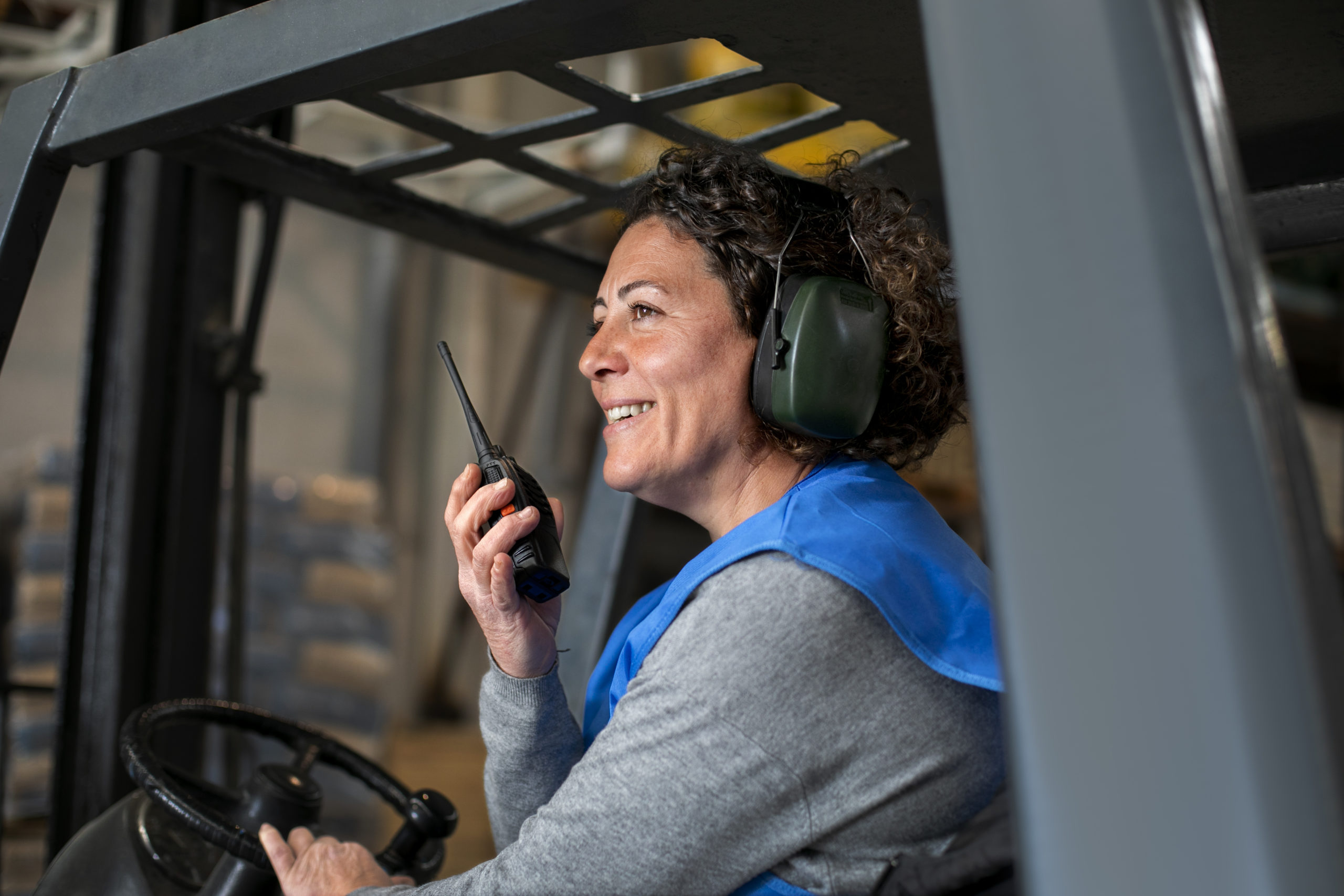
Most warehouses start with a box of PRS (UHF CB) handheld radios. They’re cheap, licence-free and work fine across a small store or a single dock. Then the business grows: the building gets bigger, the racking gets taller and denser, a yard full of containers appears, a second shift starts, and suddenly the radios that used to work are the ones everyone complains about.
“Can’t hear you, you’re breaking up.” “Say again?” “Go to the end of the aisle and try.” In a busy distribution centre, those moments cost time. When the message is about a forklift, a fire alarm or an injured worker, they cost more than that. This article explains why low-powered PRS radios struggle in large warehouses, and what a properly designed radio system looks like.
Why radios drop out at the back of the warehouse
Radio signals don’t like warehouses. Almost everything that makes a distribution centre efficient also makes it hard for radio to get through:
- Steel pallet racking. Rows of tall steel uprights and beams act like a series of walls, reflecting and absorbing the signal as it tries to pass from aisle to aisle.
- Densely packed stock. Pallets of liquids, metal goods, paper and dense products soak up radio energy. A fully stocked aisle performs very differently from an empty one.
- Shipping containers. A steel container is close to a sealed metal box. A worker inside one, or behind a stack of them in the yard, can be almost completely cut off.
- Steel cladding and insulated panels. The building shell blocks signals between inside and outside, between the warehouse floor and the yard, gatehouse or office.
- Cold stores and freezers. Insulated panels, often with foil linings, make chillers and freezers some of the hardest areas to cover.
- Sheer distance. Large distribution centres can be hundreds of metres long, with yards and gatehouses further out again.
- Noise. Forklifts, conveyors, reversing alarms and dock doors make weak, broken audio even harder to understand.
With handheld-to-handheld (simplex) radios, every message has to travel directly from one radio to another, through all of that, from about waist height. The further apart two people are and the more racking between them, the less likely it is to arrive.
The limits of PRS CB radio
PRS (Personal Radio Service, often called UHF CB) radios operate under a general user radio licence, which is why anyone can buy and use them without applying for a licence. That convenience comes with trade-offs that matter on a large site:
- Shared channels. PRS channels are shared with everyone else using PRS radios nearby — neighbouring businesses, trucks passing the site, contractors. Under the licence, frequency use is on a shared basis and there is no protection from interference.
- No private channel. You can’t have a channel of your own, so you can hear other people’s traffic, and they can hear yours.
- Direct radio-to-radio only. The general user licence doesn’t cover operating your own CB repeater, so coverage is limited to what one handheld can reach directly.
- Low-powered, consumer-grade radios. Many PRS handhelds are built for recreation, not for multi-shift industrial use, with modest transmit power, small antennas and batteries that struggle to last a full shift.
- Few safety or management features. Emergency alerts, worker location, central management and secure talk groups are generally not part of the package.
For a small site, PRS is often all you need. But once the site is large, dense or busy enough that people regularly can’t get through, adding more PRS radios doesn’t fix the problem (see five signs it’s time to upgrade your PRS CB radios). The answer is a different kind of system.
Two ways to get reliable coverage
Signals designs warehouse radio systems around two main solutions. Which one fits depends on the size of your site and how many sites you run.
Single site: a licensed DMR repeater
A repeater is a fixed radio installed in a high, central position with a properly mounted antenna. Instead of every radio trying to reach every other radio directly, each handheld only needs to reach the repeater, which re-transmits the message across the whole site. That extends coverage past the racking and steel that block radio-to-radio talk.
A typical Signals warehouse system uses a Kirisun TR850 DMR repeater, Kirisun DP405 DMR handhelds for staff and Kirisun DM588 DMR mobiles fitted to forklifts and site vehicles. Because the system runs on a licensed channel, it’s yours. It’s not shared with the business next door. Digital DMR audio stays clear across the coverage area, and separate channels can be set up for the warehouse floor, security, gatehouse and management. Signals handles the licensing, including the repeater channel.
Large or multi-site: PoC with Wi-Fi backup
For very large distribution centres, or operations spread across several linked sites, push-to-talk over cellular (PoC) is usually the better fit. PoC radios work like two-way radios but carry voice over the 4G mobile network, so one system can cover every site, yard and vehicle.
Signals’ warehouse PoC solution uses Kirisun T60 and T65 4G handhelds with Wi-Fi backup and Kirisun M50 PoC mobiles on forklifts and vehicles. Where mobile signal is weak inside the building, the radios can use the site’s Wi-Fi network instead. Teams get their own talk groups, the T60, T65 and M50 include an SOS button, and an optional web-based dispatcher console lets managers see and talk to every team from one screen.
PRS vs DMR repeater vs PoC
| PRS / UHF CB | DMR repeater | PoC with Wi-Fi backup | |
|---|---|---|---|
| Best for | Small sites, short range | Single large site | Very large or multi-site |
| Coverage | Radio-to-radio only | Whole site via central repeater | Anywhere with 4G or site Wi-Fi |
| Private channels | No — shared | Yes — licensed | Yes — private talk groups |
| Licence | General user licence | Licensed channel, handled by Signals | None needed |
| Audio | Analogue, degrades with distance | Clear digital audio | Clear digital audio |
| SOS / emergency alert | Generally no | Model-dependent | Yes on T60, T65, M50 |
| Multi-site | No | One site per repeater | Yes, one system |
| Central dispatcher | No | No | Optional web console |
Set up around the people who use it
A good warehouse radio system isn’t one channel for everyone. It’s configured around how your site runs:
| User | What they need |
|---|---|
| Warehouse staff | A clear team channel for picking, put-away and dispatch, with headsets or earpieces for noisy areas |
| Forklifts and site vehicles | Vehicle-mounted mobiles so drivers stay in contact without juggling a handheld |
| Security | A separate channel, with coverage across the yard, fence line and car parks |
| Gatehouse | Contact with the dock and yard to manage trucks arriving and leaving |
| Managers | The ability to monitor several channels and reach any team, or all teams at once |
| Emergency procedures | An all-call that reaches everyone on site for fire, evacuation or a serious incident |
Radios and warehouse safety
Forklifts remain one of the biggest risks in New Zealand warehouses. WorkSafe has warned that forklifts “have been killing and maiming people for many years” and that “it is not good enough to put some lines of paint on the ground and leave it at that.” In a 2018 prosecution following a fatal incident in which a worker was crushed by pallets falling from a forklift, WorkSafe stressed that “administrative controls like rules and procedures are simply not enough, pedestrians need to be segregated from forklift activity.”
Radios don’t replace physical separation of people and forklifts. But clear, reliable communication supports almost every other control on the site:
- Drivers and floor staff can warn each other before entering an aisle or a shared area.
- A spotter can talk a driver through a tight manoeuvre or a high lift.
- Anyone can call an immediate stop when they see a hazard.
- An injured or unwell worker, or someone working alone in a cold store or remote corner, can raise an alarm, with SOS on PoC radios.
- Every person on site hears an evacuation call at the same time.
All of that depends on the radio actually getting through at the back of aisle 40. Which is why coverage matters as much as the radios themselves.
Designed around the building, not the brochure
No two warehouses behave the same way for radio, so Signals starts with your site rather than a catalogue:
- Scope the teams. Who needs to talk to whom, and what channels or talk groups you need.
- Survey the site. Layout, racking, cold stores, mezzanines, yard and gatehouse. The places your current radios drop out.
- Choose the solution. Simplex, a DMR repeater, networked repeaters, or PoC with Wi-Fi backup.
- Licence, programme and install. Signals arranges licensing and our own technicians fit repeaters, antennas and vehicle mobiles.
- Test aisle by aisle. We test coverage on site after installation, then support the system with maintenance and network monitoring.
Running a peak season, stocktake or temporary site? Signals also offers short-term radio hire, so you can add radios without buying them.
Why warehouses choose Signals
- More than 20 years in the two-way radio industry, designing and building radio systems for New Zealand businesses.
- 312 active Radio Spectrum Management licences managed for customers. We apply for, hold and renew them for you.
- Exclusive New Zealand distributor for Kirisun.
- Around 3,500 PoC devices in the field, the largest fleet of its kind in New Zealand.
- Our own technicians in Christchurch and Auckland, working on site nationwide, with in-house repairs.
Tell us about your site. Call 0800 454 756 or email sales@signals.co.nz, and we’ll talk through where your radios struggle and which solution fits.
Related: Two-way radio for warehousing and distribution · How to choose a PoC radio · Seven reasons vehicle Wi-Fi is essential for fleets · Five signs it’s time to upgrade your PRS CB radios
Common questions
Why do our radios drop out at the back of the warehouse?
Steel racking, dense stock, containers and building cladding all block and absorb radio signals. Handheld-to-handheld radios have to reach each other directly through all of it. A repeater, or a PoC system with Wi-Fi backup, gives every radio a strong path to the network instead.
Can we just buy more powerful PRS radios?
PRS radios are limited by the general user licence, share their channels with everyone nearby and can’t use your own repeater. On a large site, a licensed repeater or PoC system will usually do far more than a higher-powered handheld.
Repeater or PoC: which do we need?
A DMR repeater suits a single site that needs strong, private coverage. PoC is usually the better fit for very large distribution centres or several linked sites, especially where you want a dispatcher console and SOS alerts.
Can different teams have their own channels?
Yes. Both systems can be set up with separate channels or talk groups for the warehouse, security, gatehouse and management, with managers able to monitor more than one.
Can you fit radios to our forklifts?
Yes. Signals fits Kirisun DM588 DMR mobiles or M50 PoC mobiles to forklifts and site vehicles, so drivers can stay in contact hands-free.
This article is general information and isn’t legal or radio licensing advice. Responsibility for health and safety compliance rests with each PCBU.
Sources
- Signals NZ — Two-way radio for warehousing and distribution: signals.net.nz/industries/warehousing-and-distribution/
- Radio Spectrum Management — Citizen Band Radio GURL: rsm.govt.nz
- NZ Gazette — Radiocommunications Regulations (General User Radio Licence for Citizen Band Radio) Notice 2011: rsm.govt.nz
- WorkSafe — Critical to address the risks from forklifts (30 June 2017): worksafe.govt.nz
- Safety News NZ — Fatal interactions between forklifts and people (2 July 2018): safetynews.co.nz