
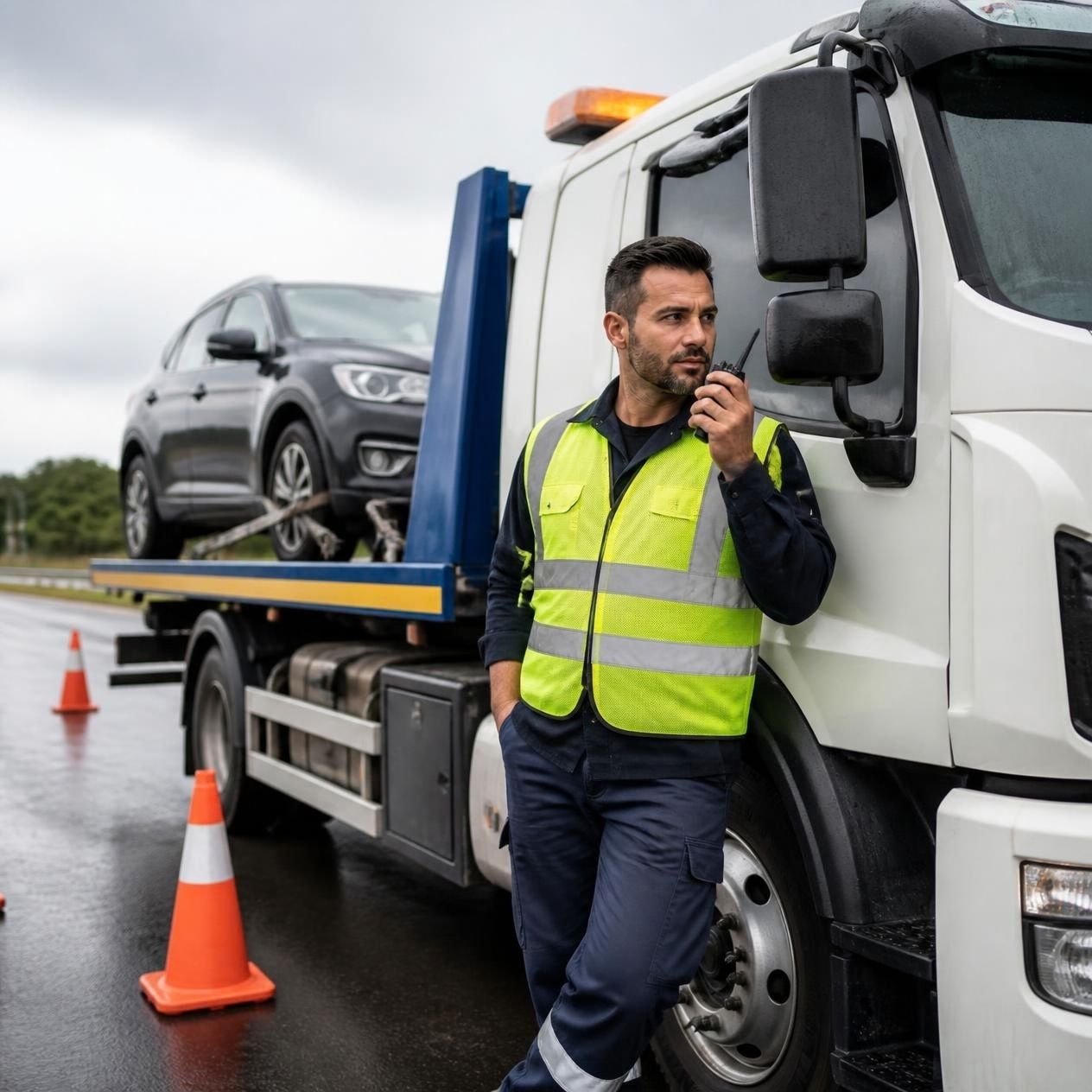
Tow and recovery operators turn up when everyone else’s day has gone wrong. A crash on the motorway at 2 am. A breakdown on a bend with no shoulder. An impound where the owner isn’t happy to see them. They work beside live traffic, often alone, in the dark and the rain, hooking up and winching heavy vehicles while drivers stream past a metre away.
That makes towing one of the most exposed jobs on New Zealand roads. Keeping operators safe takes two things working together: personal safety for the person out of the cab, and vehicle safety for the truck they rely on. This article shows how a push-to-talk over cellular (PoC) dispatch system brings them into one picture for your office.
Why towing and recovery is high-risk work
- Live traffic. Operators work on the roadside, often on high-speed roads. Breakdowns on motorways are common: in the first ten days after Transmission Gully opened, the AA noted 114 incidents, more than half involving stopped vehicles.
- Drivers who don’t slow down. In a 2025 survey of nearly 700 New Zealand road workers by the Temporary Traffic Management Industry Steering Group, half reported near misses with distracted or speeding drivers. Tow operators at a roadside job usually have far less protection than a coned worksite.
- Working alone. Many jobs are single-operator call-outs, at night and in rural areas, with nobody to raise the alarm if something goes wrong.
- Confrontation. Impounds, repossessions, private-property tows and crash scenes involving stressed or intoxicated drivers can turn aggressive quickly. Tow operators in New Zealand have been assaulted on the job.
- Heavy loads and machinery. Winching, lifting, loading and securing vehicles carry crush, entanglement and struck-by risks.
- Reversing and manoeuvring. Large tow trucks and tilt-trays are often backed into tight driveways, car parks and crash scenes with limited visibility.
- Fatigue. 24/7 on-call rosters mean long hours and night driving.
Your duties as a towing business
Under the Health and Safety at Work Act 2015, a towing and recovery business is a PCBU. It must ensure, so far as is reasonably practicable, the health and safety of its workers. The roadside, the yard and the truck are all workplaces. That means eliminating risks where you can and minimising the rest, involving your operators in the process, and having a reliable way for them to raise an alarm and get help.
Your operators also need the right licence endorsements from NZTA, including the vehicle recovery (V) endorsement. But a licence covers competence, not the controls on the job. The rest of this article focuses on those controls.
Part 1: Personal safety for tow operators
Two-way radio that works everywhere you tow
A phone call is too slow when an operator needs help, a second truck, or Police at a scene. PoC radios work like two-way radios — press and talk to dispatch or the whole team instantly — but run over the mobile network, so range is nationwide rather than limited to a single radio site or line of sight. Operators can carry a rugged handheld when they leave the cab, and an in-vehicle PoC mobile keeps the truck on the same talk group.
SOS and man-down alarms
Rugged PoC handhelds such as the Kirisun GP700 and T65 include a dedicated SOS button that sends an emergency alert, with the operator’s location, straight to dispatch and nominated colleagues. Man-down detection on supported models raises an automatic alarm if an operator falls, is struck or stops moving, even if they can’t press anything. For a single operator recovering a vehicle down a bank at night, that can be the difference between a fast response and nobody knowing.
GPS location of the person, not just the truck
Vehicle tracking tells you where the truck is parked. A handheld with GPS tells you where the operator is. They may be walking down the motorway to a crash, at the back of a property, or out of sight of the truck. When an alarm comes in, dispatch knows exactly where to send help.
Body-worn cameras
Body-worn cameras are increasingly common in roles that face confrontation. A visible camera often de-escalates a tense situation before it starts, and the recording provides evidence if there’s an assault, a damage claim or a complaint about how a tow was carried out. The Kirisun D5 combines a body-worn camera with push-to-talk on the same PoC network, so it can be used as both radio and camera, with video available to dispatch. The compact Kirisun DSJ-F9S is a lighter recording-only option.
Part 2: Vehicle safety for tow trucks
Lights that get you seen
Being seen early is the first line of defence on the roadside. Under the Land Transport Rule: Vehicle Lighting 2004, a vehicle recovery service vehicle may be fitted with one or more amber beacons. The rule requires beacons to be positioned for maximum visibility, flash no more than six times per second and not dazzle other road users.
A quality LED safety light bar gives approaching drivers more warning than a single beacon, especially at night, in rain and on high-speed roads. Add scene and work lights so operators can see what they’re hooking up and be seen by passing traffic while they do it. Signals’ Safety Light Bar comes in compact and large sizes to suit light tow trucks through to heavy recovery units, and our technicians can also install lighting hardware you supply.
Reversing cameras
Tow trucks and tilt-trays have large blind spots behind them, and they’re often reversed into driveways, car parks and crash scenes with people around. A reversing camera with a cab monitor and night vision gives the driver a clear view of what’s behind the truck: people, bollards, and the vehicle being recovered. This reduces reliance on someone waving them back, a luxury not every operator has.
Dash cameras
A forward-facing dash camera records what happens on the road: near misses, crashes and other drivers’ behaviour. That footage protects your business against false claims and disputes, supports insurance claims, and gives you real examples for driver coaching. Dual-facing cameras can also show what was happening in the cab, if your policy and drivers agree to it.
GPS fleet tracking
GPS tracking gives you live location for every truck, along with the data that shapes driver safety — speeding, harsh braking and acceleration, idle time and after-hours use. It also gives you an accurate record of when a truck arrived on scene and left, which is useful for billing and job disputes. Signals’ Waka Data platform covers fleet tracking, and through our partnership with RUC Monkey can also manage your road user charges.
Part 3: How PoC dispatch brings it all together
Personal and vehicle safety tools work best when someone is watching the whole picture. A PoC dispatcher console puts your operators, trucks and alarms on one browser-based screen in your office.
| Dispatch capability | How it helps safety and operations |
|---|---|
| Live map of every operator and truck | Send the nearest truck to a job or a crash, and see where an operator is when an alarm comes in |
| Instant voice to one operator, a group or everyone | Give job details without phone tag; warn all trucks about a hazard, road closure or weather event at once |
| Talk groups | Separate groups for light towing, heavy recovery, motorway or contract work, and the yard |
| SOS and man-down alerts | Alarms arrive at dispatch with the operator’s location, so help can be sent immediately |
| Live audio and video | Hear what’s happening and, with a PoC body camera like the D5, see the scene |
| Check-ins on high-risk jobs | Dispatch confirms an operator is safe at the start and end of an impound, repossession or night recovery |
| Call recording and history | A record of what was said and where crews were, for job disputes and incident reviews |
Here’s how it works in practice. An operator is sent to a breakdown on a dark rural highway. Dispatch allocates the job by voice and watches the truck arrive on the map. The operator wears a body camera and carries a handheld as they walk to the vehicle. If a passing car clips them, man-down triggers an alarm to dispatch with their exact location; if the vehicle owner becomes aggressive, one press of the SOS button brings dispatch onto the channel, recording, while help is sent. Meanwhile, the truck’s light bar, dash camera and GPS have been doing their job in the background.
Risk and control summary
| Risk | Control | Signals solution |
|---|---|---|
| Struck by passing traffic | Visibility, early warning, fast alarm | Safety light bars, man-down radios, PoC dispatch |
| Working alone | Reliable contact, SOS, location | Kirisun GP700, T60, T65 PoC handhelds |
| Aggression and assault | Deterrence, evidence, instant alarm | Kirisun D5 and DSJ-F9S body cameras, SOS |
| Reversing incidents | Rear visibility | Reversing camera kit with night vision |
| Road incidents and disputes | Video evidence, driver coaching | Dash cameras, GPS tracking |
| Unsafe driving and fatigue | Monitoring and feedback | Waka Data GPS tracking |
A safety checklist for towing and recovery fleets
- Can every operator raise an alarm when they’re out of the cab — even if they can’t press a button?
- Does dispatch always know where each operator and truck is?
- Who receives SOS alarms after hours, and what happens if they don’t respond?
- Are trucks fitted with lighting that gives approaching drivers enough warning at night and on high-speed roads?
- Do drivers have a clear view behind the truck when reversing?
- Do you have video evidence for road incidents and confrontations, and a policy covering it?
- Are high-risk jobs (impounds, repossessions, night recoveries) covered by check-ins?
- Do operators working in remote areas carry a registered PLB?
- Have operators been involved in reviewing these risks, and trained on the equipment?
Why towing and recovery fleets choose Signals
- One supplier for people and vehicles — PoC radios, body cameras, light bars, reversing cameras and GPS tracking, designed to work together.
- New Zealand’s PoC pioneer — Signals built the country’s first push-to-talk over cellular network in 2018 and supports around 3,500 PoC devices in the field.
- Exclusive New Zealand distributor for Kirisun, including PoC handhelds, mobiles, body cameras and the Kirisun web dispatcher console.
- We fit it ourselves — our own technicians install radios, lights, cameras and GPS at the same time, so trucks are off the road once, not three times.
- Christchurch and Auckland bases, working on site nationwide, with in-house repairs and quick turnarounds.
Scope your free trial. We’ll look at how your fleet operates, set up talk groups and the dispatcher, and put demo radios and cameras in your operators’ hands. Call 0800 454 756 or email sales@signals.co.nz.
Related: Lone worker safety in New Zealand · A scalable lone worker app · Seven ways PoC radio improves traffic management
Common questions
Can tow trucks use amber beacons in New Zealand?
Yes. The Land Transport Rule: Vehicle Lighting 2004 allows a vehicle recovery service vehicle to be fitted with one or more amber beacons, provided they are positioned for maximum visibility, flash no more than six times per second and don’t dazzle other road users.
What is PoC dispatch?
Push-to-talk over cellular (PoC) dispatch is a browser-based console that lets your office talk to operators by radio, see their location on a map, receive SOS alerts and manage talk groups, all over the mobile network.
Are body-worn cameras worth it for tow operators?
For operators who handle impounds, repossessions or confrontational scenes, body cameras can deter aggression and provide evidence if something goes wrong. A clear policy on recording and privacy is essential.
What’s the difference between vehicle GPS and radio GPS?
Vehicle GPS tracks the truck, including speed and driving behaviour. GPS in a handheld radio tracks the operator, which matters when they’re working away from the truck and need help.
Do PoC radios work in remote areas?
PoC radios work wherever there’s mobile coverage. For remote recoveries without coverage, pair them with a registered personal locator beacon, or talk to us about extending coverage with vehicle Wi-Fi.
This article is general information and isn’t legal advice. Responsibility for health and safety compliance rests with each PCBU.
Sources
- NZTA — Land Transport Rule: Vehicle Lighting 2004, clause 11 (beacons): nzta.govt.nz
- NZTA — Applying for a vehicle recovery (V) endorsement: nzta.govt.nz
- AA — Motorway breakdowns: what should you do?: aa.co.nz
- TTM-ISG — Road worker survey media release (October 2025): ttm-isg.org
- Signals NZ — Safety equipment: signals.net.nz/product-category/safety-equipment/